
Research use only. Not for use in humans or animals. All products and information on this site are provided strictly for in-vitro laboratory research purposes. They are not for use in humans or animals, and are not drugs, foods, cosmetics, or medical devices.
What Is BPC-157? A Complete Research Overview
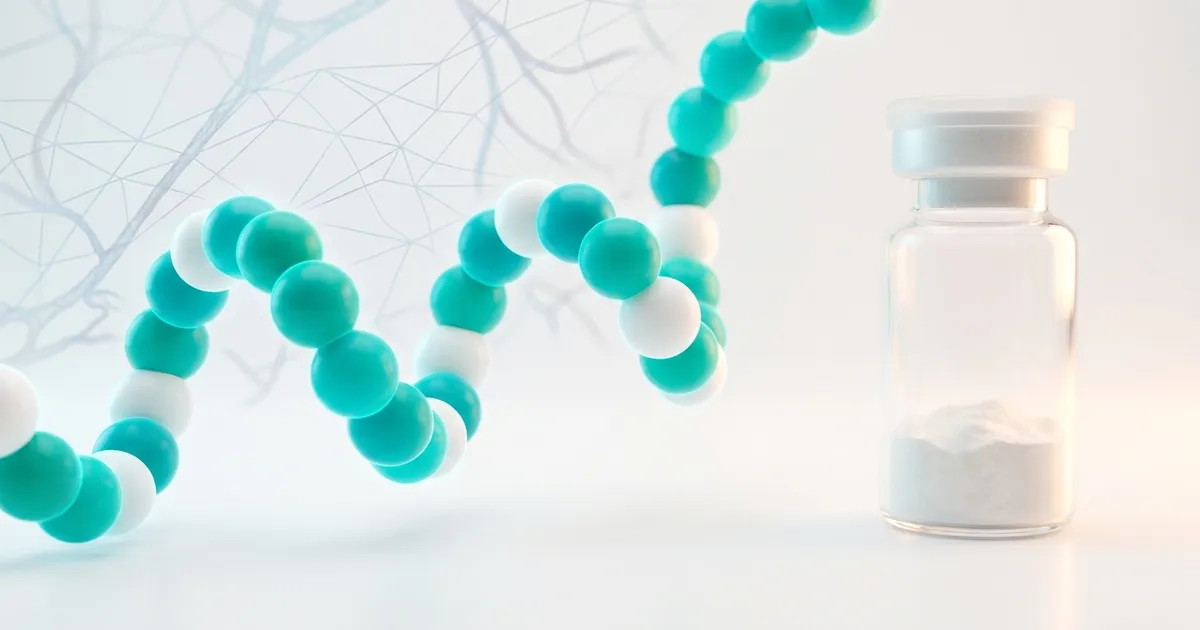
BPC-157 (Body Protection Compound-157) is a synthetic pentadecapeptide — a chain of 15 amino acids derived from a partial sequence of a protein found in human gastric juice. It is one of the most-studied research peptides in laboratory models of angiogenesis, connective-tissue repair, and gastrointestinal biology. This overview covers what BPC-157 is, what it is studied for, and how to verify research-grade material.
BPC-157 at a glance
| Property | Value |
|---|---|
| Name | BPC-157 (Body Protection Compound-157) |
| Class | Synthetic pentadecapeptide (15 amino acids) |
| Sequence | Gly-Glu-Pro-Pro-Pro-Gly-Lys-Pro-Ala-Asp-Asp-Ala-Gly-Leu-Val |
| Molecular formula | C₆₂H₉₈N₁₆O₂₂ |
| Molecular weight | ~1419.6 g/mol |
| CAS number | 137525-51-0 |
| Appearance | White to off-white lyophilized powder |
Research background
BPC-157 is a partial sequence derived from BPC (Body Protection Compound), a protein identified in gastric juice. It is a stable peptide — a property that made it attractive for laboratory study — and does not occur naturally in this exact 15-amino-acid form; it is produced by solid-phase peptide synthesis.
What BPC-157 is studied for
In laboratory research (in-vitro assays and animal models), BPC-157 is studied for its role in:
- Angiogenesis — formation of new blood vessels and vascular signaling in tissue-model systems.
- Fibroblast and tendon-cell biology — cell migration and connective-tissue-repair models.
- Nitric-oxide (NO) signaling — interaction with the NO pathway in vascular research.
- Gastrointestinal mucosa — models of gut-lining integrity, reflecting the peptide's gastric origin.
- Growth-factor expression — studies reporting changes in growth-factor receptor expression in cultured cells.
This is laboratory research; BPC-157 offered here is a research chemical only, not for use in humans or animals.
BPC-157 vs TB-500
BPC-157 and TB-500 are frequently discussed together in tissue-repair research because they act through different proposed mechanisms — BPC-157 in angiogenesis and NO signaling, TB-500 (a fragment related to thymosin β4) in actin regulation and cell migration. They are sometimes studied as a blend. For a full structural comparison, see BPC-157 vs TB-500 →.
Forms of BPC-157 studied
- Standard BPC-157 — the synthetic pentadecapeptide described above.
- BPC-157 arginate (stable BPC-157) — an arginate salt form studied for improved stability in solution.
Both are research materials. The arginate form is sometimes preferred in studies that require extended solution stability.
How research-grade material is verified
Every batch that ships from a credible US supplier should arrive with a third-party Certificate of Analysis (COA) for that exact lot. Peptide Technologies publishes a COA on every batch and links it to a QR code on the vial. A complete COA reports:
- Identity — mass spectrometry (ESI-MS) confirming the observed mass matches the theoretical mass of the target sequence.
- Purity — reverse-phase HPLC, reported as percent peak area at a fixed wavelength (typically 220 nm). Research-grade material is ≥99% by area.
- Net content — gravimetric confirmation the vial holds the stated mass within tolerance.
- Endotoxin — LAL assay below research-grade thresholds.
If a vendor cannot show you a lot-specific COA, you cannot verify what is in the vial. Browse the full COA library →
How to source research-grade material
For laboratory research, sourcing quality comes down to a few checks:
- Lot-specific COA from an accredited, independent laboratory — not a generic marketing PDF.
- HPLC purity ≥99% by peak area, with the chromatogram shown.
- US synthesis and finishing, so the chain of custody is documented end to end.
- Cold-chain shipping for lyophilized material, so the product arrives stable.
Peptide Technologies meets each of these and publishes a third-party COA for every lot. Browse the public COA library →
FAQ
What is BPC-157?
BPC-157 is a synthetic pentadecapeptide (15 amino acids) derived from a partial sequence of a protein in human gastric juice. It is studied in laboratory models of angiogenesis, connective-tissue repair, and gastrointestinal biology.
Is BPC-157 a peptide?
Yes. BPC-157 is a short peptide of 15 amino acids, produced by solid-phase peptide synthesis and verified by HPLC and mass spectrometry.
What is the sequence of BPC-157?
The sequence is Gly-Glu-Pro-Pro-Pro-Gly-Lys-Pro-Ala-Asp-Asp-Ala-Gly-Leu-Val, with a molecular weight of approximately 1419.6 g/mol.
What is the difference between BPC-157 and TB-500?
Both are studied in tissue-repair research but through different proposed mechanisms: BPC-157 in angiogenesis and nitric-oxide signaling, TB-500 in actin regulation and cell migration.
How is BPC-157 verified?
Research-grade BPC-157 is verified by HPLC (≥99% purity by peak area), mass spectrometry (observed mass ~1419.6 Da), and an LAL endotoxin assay, all reported on a lot-specific third-party COA.
Is BPC-157 stable in solution?
Standard BPC-157 is a relatively stable peptide; an arginate salt form is also studied for extended solution stability.