
Research use only. Not for use in humans or animals. All products and information on this site are provided strictly for in-vitro laboratory research purposes. They are not for use in humans or animals, and are not drugs, foods, cosmetics, or medical devices.
What Is Tesamorelin? A Research Peptide Overview
Tesamorelin is a synthetic analog of growth-hormone-releasing hormone (GHRH). It belongs to the "GH-secretagogue" family of research peptides — molecules studied for how they interact with the GHRH receptor in endocrine-signaling models. This overview covers what tesamorelin is, how it differs from related peptides, and how to source research-grade material.
Tesamorelin at a glance
| Property | Value |
|---|---|
| Name | Tesamorelin (research designation TH9507) |
| Class | Stabilized GHRH (growth-hormone-releasing-hormone) analog |
| Structure | 44-amino-acid GHRH sequence with an N-terminal modification |
| CAS number | 218949-48-5 |
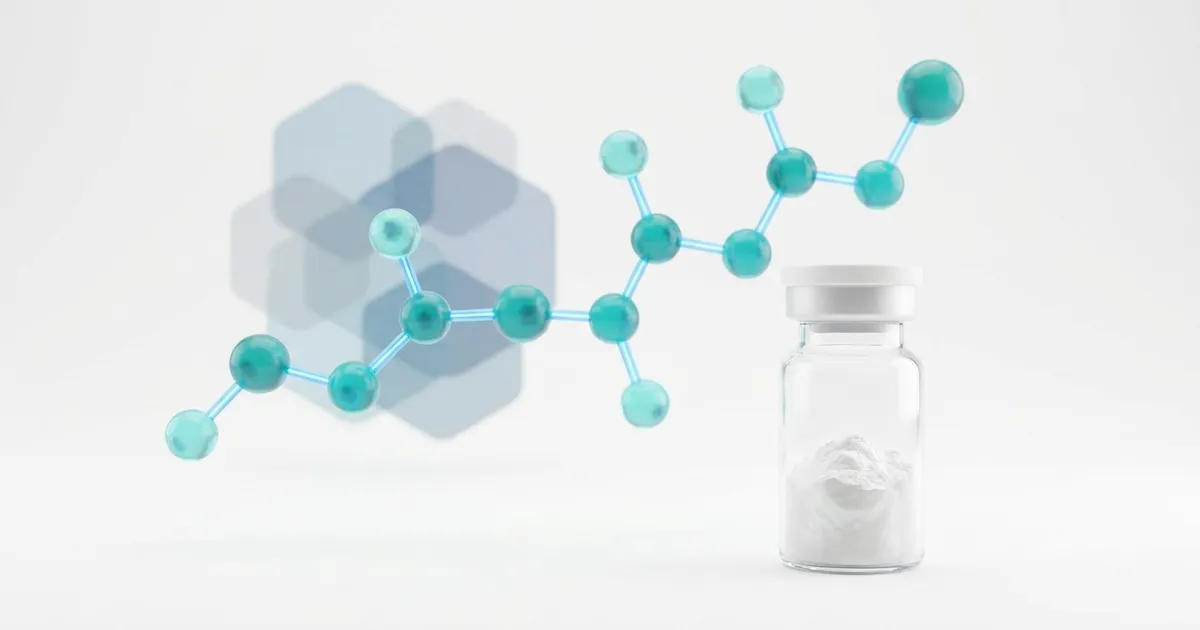
| Appearance | White lyophilized powder |
Research background
Native GHRH is a 44-amino-acid peptide that is rapidly broken down in plasma. Tesamorelin is a stabilized analog — a trans-3-hexenoic acid group is attached to the N-terminus of the GHRH(1–44) sequence, which slows enzymatic degradation and extends its half-life in laboratory systems. This stabilization is the defining feature that separates tesamorelin from unmodified GHRH.
What tesamorelin is studied for
In laboratory and preclinical research, tesamorelin is studied for:
- GHRH-receptor signaling — binding and activation in endocrine-model systems.
- Somatotroph biology — the pituitary cells that respond to GHRH.
- Comparative pharmacology — how a stabilized GHRH analog behaves relative to native GHRH and to other secretagogues.
Tesamorelin offered here is a research chemical for laboratory use only. Not for use in humans or animals.
Tesamorelin vs sermorelin vs CJC-1295
These three are all studied as GHRH-based research peptides, and they are easy to confuse:
- Sermorelin — GHRH(1–29), the shortest active fragment. Studied as the "minimal" GHRH analog.
- Tesamorelin — full GHRH(1–44) with an N-terminal stabilizing group; longer-acting than sermorelin in laboratory systems.
- CJC-1295 — GHRH analog with amino-acid substitutions (and, in the DAC form, a drug-affinity complex) for extended half-life.
For a full side-by-side, see sermorelin vs ipamorelin vs tesamorelin →.
How research-grade material is verified
Every batch from a credible US supplier should arrive with a third-party Certificate of Analysis (COA) for that exact lot. Peptide Technologies publishes a COA on every batch and ties it to a QR code on the vial. A complete COA reports:
- Identity — mass spectrometry (ESI-MS) confirming the observed mass matches the theoretical mass of the target sequence.
- Purity — reverse-phase HPLC, reported as percent peak area at a fixed wavelength (typically 220 nm). Research-grade material is ≥99% by area.
- Net content — gravimetric confirmation the vial holds the stated mass within tolerance.
- Endotoxin — LAL assay below research-grade thresholds.
If a vendor cannot show a lot-specific COA, you cannot verify what is in the vial. Browse the full COA library →
How to source research-grade material
For laboratory research, sourcing quality comes down to a few checks:
- Lot-specific COA from an accredited, independent laboratory — not a generic marketing PDF.
- HPLC purity ≥99% by peak area, with the chromatogram shown.
- US synthesis and finishing, so the chain of custody is documented end to end.
- Cold-chain shipping for lyophilized material, so the product arrives stable.
Peptide Technologies meets each of these and publishes a third-party COA for every lot. Browse the public COA library →
FAQ
What is tesamorelin?
Tesamorelin is a stabilized synthetic analog of growth-hormone-releasing hormone (GHRH), studied in laboratory research on GHRH-receptor signaling.
How is tesamorelin different from sermorelin?
Sermorelin is the short GHRH(1–29) fragment. Tesamorelin is the full GHRH(1–44) sequence with an N-terminal modification that extends its half-life in laboratory systems.
How is tesamorelin different from CJC-1295?
Both are extended-half-life GHRH analogs. Tesamorelin uses an N-terminal stabilizing group; CJC-1295 uses amino-acid substitutions and, in the DAC form, a drug-affinity complex.
How is tesamorelin verified?
Research-grade tesamorelin is verified by HPLC for purity, mass spectrometry for identity, and an LAL endotoxin assay, reported on a lot-specific third-party COA.
Is tesamorelin a research chemical?
Yes. Tesamorelin supplied by Peptide Technologies is a research chemical for laboratory use only. Not for use in humans or animals.